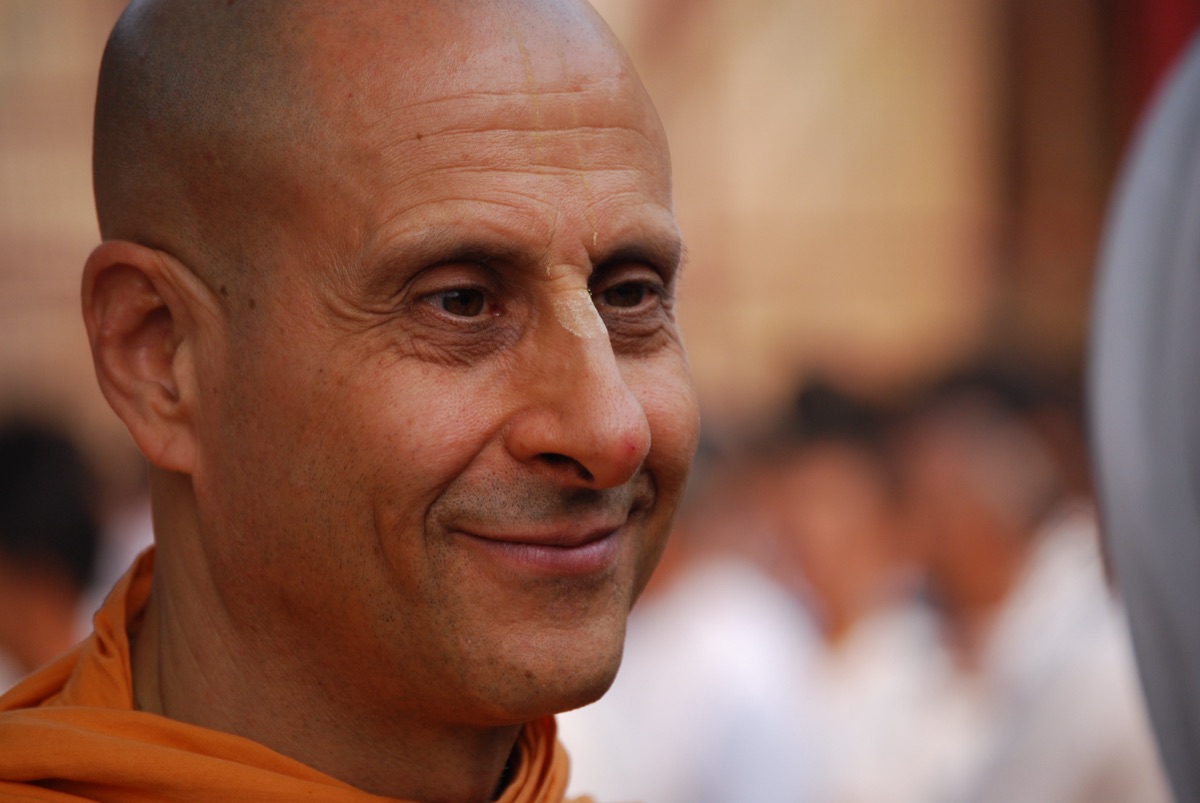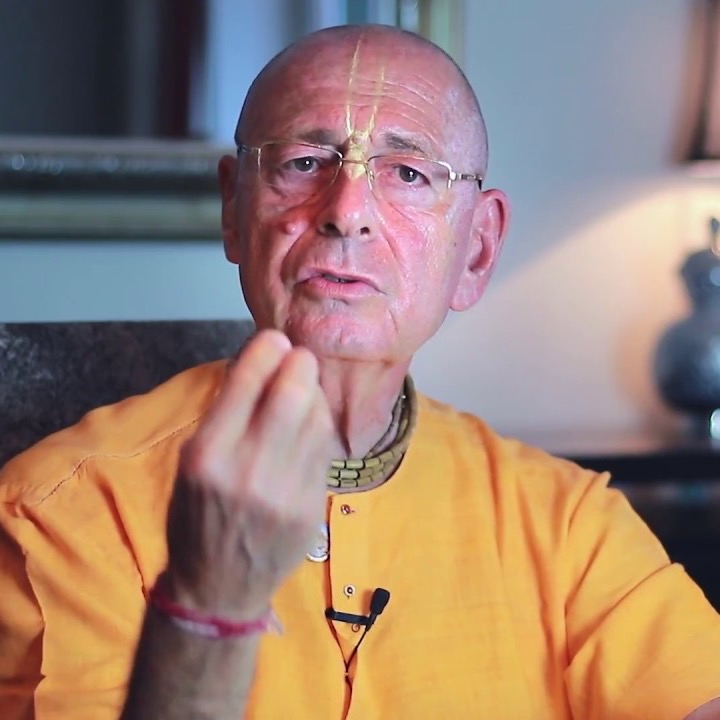

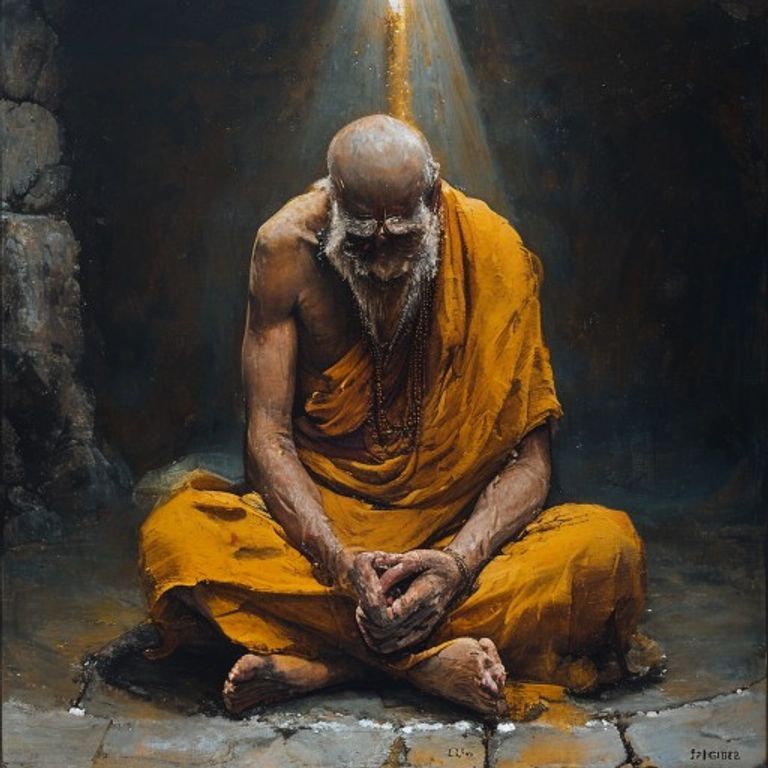
The old man sat on a low cushion in a seminar room somewhere in the Russian winter, a microphone clipped to his sweater, and said the thing that froze everyone listening. Almost fifty years of chanting. Decades of service. And looking back, he said, it was all nothing. Imagination. A long, elaborate self-deception. When that realization came, he admitted, it did not humble him into peace. It pushed him to the edge of taking his own life.
He said it gently, the way you confess something you have made your peace with. A younger devotee near the front nodded slowly, the way people nod when they think they are watching someone brave. The room received it as wisdom.
Here was a senior devotee baring his soul, refusing to pretend, naming his own hypocrisy out loud. It sounded like the deepest humility anyone in that room had heard in years. It was not humility. It was a man drowning and calling the water grace. And the younger devotee nodding at the front. He was learning to drown too.
This is not about one teacher. He is sincere, and his honesty is real, and nothing here is meant to wound him. It is about a pattern that wears the most convincing disguise in all of spiritual life. The disguise of humility. And it is quietly killing the faith, sometimes the will to live, of people who came to bhakti for exactly the opposite.
When Humility Curdles
Real humility is sweet. It softens a person. It makes him grateful, hopeful, eager to serve, quick to honor others. It looks up. What this devotee described was something else. He said his practice had produced nothing. He said studying scripture “does not help at all.” He said he and his peers were more fallen than the drunkards on the street, because at least the drunkards were honest. Each statement, alone, can be dressed in the robes of self-effacement.
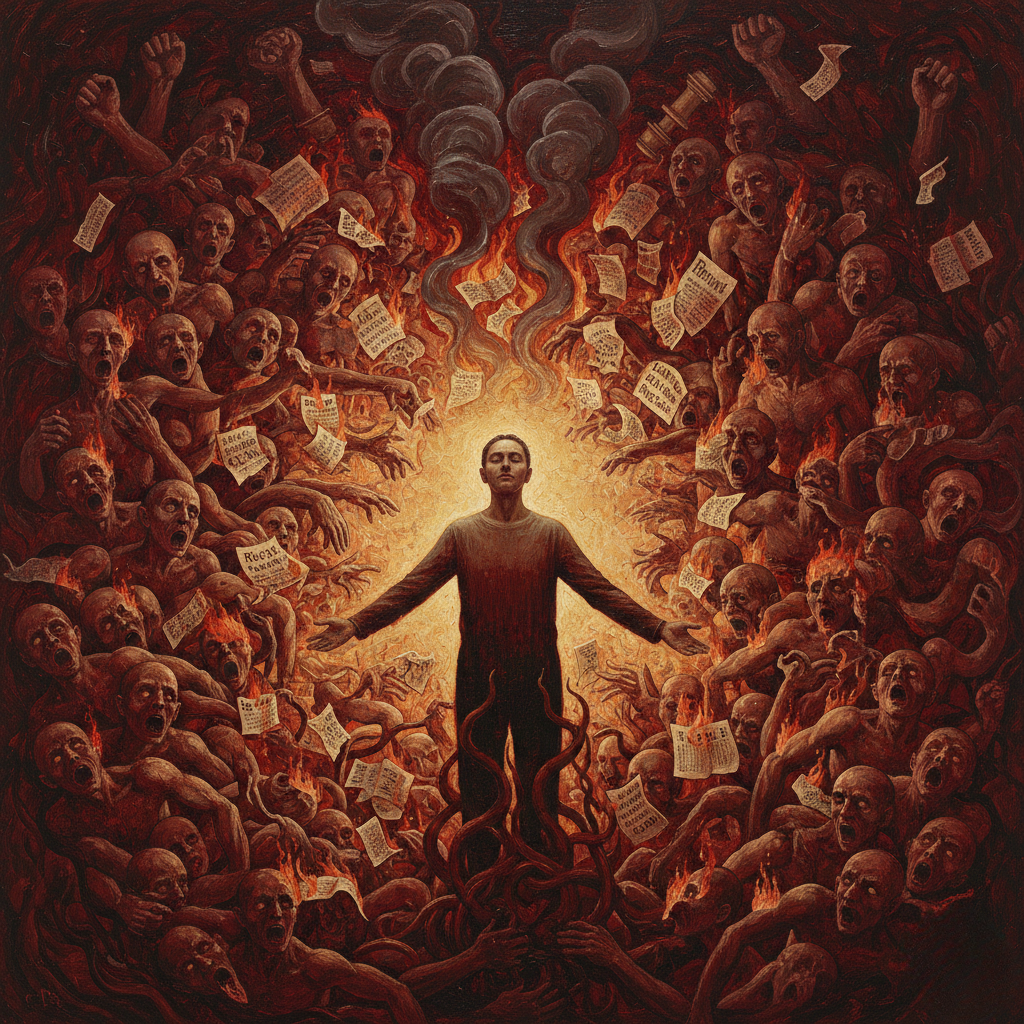
Strung together, they form a confession of total spiritual bankruptcy, delivered from a teaching seat, to people who came looking for hope. Call it what it is. Spiritual despair. The settled conviction that one’s devotional life amounts to zero, that the books are useless, that the years were a fraud. It feels like the floor of humility. It is actually the bottom of a well.
And the man at the bottom, gentle and sincere, is teaching others how to climb down after him. The tradition has a precise word for the genuine version of this experience, and that word is not despair. We will reach it. First we have to see how many different people, in how many different costumes, end up at the lip of the same well.
Four Faces of the Same Despair
The pattern rarely announces itself. It hides inside language everyone in the room respects. Watch it wear four different faces.
The Senior Who Sees Through Everything
Govinda has chanted for half a lifetime. He has held posts, given classes, trained newcomers. Then the weeds clear and he sees how much of it was ego. Instead of grieving the ego and keeping the devotion, he throws out both. “It was all nothing,” he tells his students, and they write it down as realization. He is not lying. He is generalizing a true insight about his pride into a false verdict on his bhakti. From the seat, the verdict spreads.
The Young Devotee Who Quit Trying
Anton is thirty and has stopped rising for morning program. When his friend gently asks, Anton has an answer ready, and it sounds advanced. “I am too fallen for that. Real surrender is admitting you can do nothing.” He has discovered that the language of self-abasement is the perfect shelter. As long as he calls himself the lowest, no one can ask him to get up. His despair is not a wound. It is a permission slip.
The Devotee in Love With the Wound
Lalita reads the saints who wept, who called themselves worthless, who burned with separation, and she wants that. So she cultivates the ache. She narrates her own unworthiness with a kind of relish, returning again and again to how hopeless she is, how dark her heart. She has mistaken the scenery of the path, the suffering, for the destination. The weeping of the great souls flowed from love. Hers flows from a mirror.
The Seeker Who Closed the Book
Bhakta Mikhail came through years of reading and finally reached a teacher who told him study does not help. Relieved, he stopped. The speculation that puffed up his mind is gone, which is good. But so is his hearing, his Bhagavatam, his daily contact with the words of the pure devotee.
He calls this simplicity. In truth he has cut the rope while sitting at the bottom of the well, and called the cutting wisdom. Four people. One destination. None of them looks like a person abandoning Krishna. Every one of them looks, to the room, like a person getting serious about humility.
The Weed That Looks Like a Flower
Something does collapse after decades of practice. Govinda was not lying about that. The question is what collapsed. The acharyas teach that even from devotional service, subtle weeds grow. Srila Visvanatha Cakravarti Thakura, in his Madhurya-kadambini, names them with surgical care. Among them: labha, puja, pratistha. Profit, adoration, prestige.
The desire to be seen as advanced. To sit higher. To be the senior whose words the room receives as wisdom. Pratistha is the last weed and the hardest to pull, because it grows inside devotion itself and looks exactly like the plant it is strangling. For decades a person can mistake the pleasure of being respected for the taste of bhakti.
He can mistake the identity of “advanced practitioner” for the soul’s actual service. The whole structure feels spiritual. It is built on sand. Then comes anartha-nivritti, the clearing of the weeds. The light turns on. The man sees that much of what he called realization was ego wearing saffron. Here is the hinge on which everything turns. He had fused his sense of self with that spiritual persona. So when the persona was exposed as hollow, it did not feel like losing a weed. It felt like dying.
But he does not die. Only the costume does. Krishna is explicit in Bhagavad-gita 2.20: “For the soul there is neither birth nor death at any time… He is not slain when the body is slain.” The soul is untouched by these collapses. Govinda grieved the death of a mask as though it were the death of a man. That is the engine of the despair. Not too much honesty. A subtle, decades-old case of mistaken identity.
There is a second crack in the foundation. He said he had relied on his own efforts. He treated advancement as something to accumulate by personal exertion, like savings in a bank. But bhakti does not work like savings. It descends. It is given. A self-made spirituality is built to collapse the moment it fails to manufacture love, because love was never something he could manufacture in the first place.
The Dostoevsky in the Temple Room
Here is what makes this particular collapse so recognizable, and so important to name. The shape of his despair was not random. It was inherited. A devotee does not stop being the product of his culture the day he takes initiation. He brings his whole inner architecture with him, and that architecture quietly bends how he receives the teaching. This man spoke as a Vaishnava. He suffered as a character out of Dostoevsky.
Consider the inheritance. He used a specifically Russian Orthodox word for spiritual self-deception, a term from the ascetic tradition that teaches deep suspicion of one’s own spiritual experiences as possible delusion. So he distrusted his fifty years on principle, before examining them. He carried the old ideal of self-abasement, where calling yourself the worst of sinners is a mark of holiness, not alarm.
So “more fallen than the drunkards” felt like sanctity. He carried the cultural maximalism that refuses the middle and demands the absolute, the all or the nothing. So a stage of purification became total annihilation. Fifty years equals zero. He carried the reverence for redemptive suffering, the conviction that the soul nearest God is the soul in anguish. So the abyss felt like a station on the path rather than a wrong turn.
And he carried a hard-earned distrust of every institution, the residue of a century that taught people the official story is always a lie. So religious leaders became demons in his telling, and organized devotion itself became suspect.
None of this is a personal failing. It is a borrowed darkness, beautiful and tragic and deeply human. But it is not bhakti. And when that cultural mold pours itself into the teaching of Sri Caitanya Mahaprabhu, it can drag a path of boundless joy down into a Russian winter of the soul.
This reaches far beyond one nationality. Every one of us pours bhakti into the mold of our conditioning. The Westerner makes it about self-improvement. The achiever makes it about accumulation. The wounded make it about proving they are worthless. The point is not to mock the mold. The point is to notice it, so that scripture can correct it instead of being bent by it.
What the Acharyas Actually Say
Place the three claims beside the words of guru, sadhu, and shastra, and watch them dissolve. He said his service amounted to nothing. Krishna says the opposite, without qualification. Bhagavad-gita 2.40 states: “In this endeavor there is no loss or diminution, and a little advancement on this path can protect one from the most dangerous type of fear.”
Read it slowly. No loss. No diminution. Not “your sincere efforts mostly survive.” Nothing devotional is ever erased. Not one round, not one morning at the altar, not one act of service rendered across fifty years. Krishna repeats the promise in Bhagavad-gita 6.40: “A transcendentalist engaged in auspicious activities does not meet with destruction either in this world or in the spiritual world; one who does good, My friend, is never overcome by evil.”
So to stand before sincere people and declare that half a century of devotional life was nothing is not humility. It is, however unintentionally, calling Krishna a liar. The ego that was exposed was indeed nothing. The bhakti underneath it was never lost. He said studying does not help. But hearing is not an obstacle to devotion.
It is the first and chief limb of it. In Srimad-Bhagavatam 7.5.23, Prahlada Maharaja lists the nine processes of pure devotional service, and he begins with sravanam, hearing. The seed itself arrives this way. Caitanya-caritamrta Madhya 19.151 teaches that “by the mercy of both Krishna and the spiritual master, such a person receives the seed of the creeper of devotional service.”
What is useless is dry mental speculation that never softens into service. What is essential is submissive hearing from the pure devotee. To collapse the two, and tell people study is worthless, hands them a reason to abandon the one lifeline that could pull them out. And there is a harder possibility he named himself.
He confessed he had never developed real love for a single devotee, that he hid behind a performance of being a servant. The tradition warns where that leads. Caitanya-caritamrta Madhya 19.156 compares an offense against a Vaishnava to “a mad elephant” that uproots the tender creeper of devotion and leaves its leaves dried up.
A heart with no living bond to a single Vaishnava, watering its practice in isolation for decades while the creeper withers, will one day find the plant dead and conclude the gardening was a fraud. The problem was never that he served too long. The problem was a creeper trampled by isolation and self-concealment.
The High Cost of Holy Despair
This would be a private tragedy if it stayed private. It does not. Despair dressed as humility is contagious, and it spreads fastest from the very seats meant to give shelter.
It is taught
When a senior devotee announces from a class that his life of service came to nothing, he is not confessing. He is instructing. Everyone younger files it away as the mature view, the advanced view, the honest view. Despair acquires authority.
It is inherited
The newcomer who arrived hungry for hope absorbs the lesson that even fifty years lead nowhere. Why rise at four. Why chant with care. The message that effort is pointless reaches the one person who most needed to be told the opposite.
It is mistaken for depth
A community can come to prize this melancholy, to treat the gloomiest devotee as the most realized, to confuse a heavy heart with a deep one. Joy starts to look shallow. Hope starts to look naive. The whole emotional temperature of the bhakti drops, and people call the cold profundity.
It empties the room
Eventually some of them leave. Not because the philosophy failed them, but because a counterfeit of the philosophy told them there was nothing at the end of the road. They walk away from the very shelter that would have saved them, convinced they are walking away from a dead end.
The cost is not abstract. It is the morning a man decides his fifty years were worthless and reaches for the rope. It is the young devotee who quietly stops believing anything will ever bloom.
The Way Back to Hope
So the realization that the ego was hollow, that is real. That is anartha-nivritti, a genuine stage, not a tragedy. Why did it nearly kill him? Because he received it without shelter.
There is a stage where a devotee sees his own insignificance with total clarity. The tradition does not call it despair. It calls it dainya, and it is a limb of surrender, of saranagati. The difference between dainya and despair is not the seeing. Both see the self as small.
The difference is what the small self does next. Despair looks down and concludes there is no point. Dainya looks up and reaches for the rope. One ends in the well. The other ends in the hands of Krishna. Strip the seeing of its hope and its shelter, and it stops being Vaishnava realization and becomes the impersonalist’s void in devotional costume.
“I am nothing” without “and therefore I depend entirely on Your mercy” is not surrender. It is annihilation. This devotee, shaped by a culture that romanticizes the abyss, received a true insight and let it curdle into the very nihilism the philosophy exists to cure.
Sri Caitanya Mahaprabhu mapped the way out in advance. In Caitanya-caritamrta Antya 20.21 He teaches the disposition that makes constant chanting possible: “One who thinks himself lower than the grass, who is more tolerant than a tree, and who does not expect personal honor but is always prepared to give all respect to others can very easily always chant the holy name of the Lord.”
Lower than the grass. That is lowly enough for any honest self-examination. But notice the result. Not the rope. The easy, continuous chanting of the holy name. Genuine lowliness opens the mouth in kirtan.
Counterfeit lowliness closes the throat in grief. If you recognize yourself in Govinda, or Anton, or Lalita, or Mikhail, understand this first. You have not failed spiritually. You have made a philosophical error, and errors can be corrected, starting today. Refuse the maximalist lie. Your years were not nothing. Bhagavad-gita 2.40 forbids that conclusion.
Every round survives. Every service is held. The ego that inflated those years may have been hollow, but the devotion beneath it is eternal capital that no failure can touch. Grieve the mask if you must. Do not bury the soul with it.
Change the direction of your gaze. The seeing of your smallness is correct. Aim it upward. Let “I am nothing” finish its sentence the way the acharyas finish it: “and therefore I throw myself entirely on the mercy of guru and Krishna.” That is not a smaller statement than despair.
It is a braver one. It asks you to hope. Build the one thing he confessed he never had. A real relationship with a real devotee. Not a performance of servitude, not a role played for the seminar room, but one honest friendship in which the heart is actually open. The creeper of devotion grows in that soil and nowhere else.
And return to hearing. Not dry speculation that swells the mind, but submissive hearing from a sadhu, the first limb of devotion in Srimad-Bhagavatam 7.5.23. The light that dispels the darkness is not your own effort manufacturing realization. It is mercy descending.
Caitanya-caritamrta Adi 1.2 describes Sri Caitanya and Lord Nityananda as the sun and the moon, risen together “to dissipate the darkness of ignorance.” Your work is not to generate the dawn. It is to stop boarding up the windows.
The old man in the seminar room had it half right, and the half he got wrong nearly killed him. He saw the darkness clearly. He simply forgot that the entire point of the philosophy is the sunrise.