
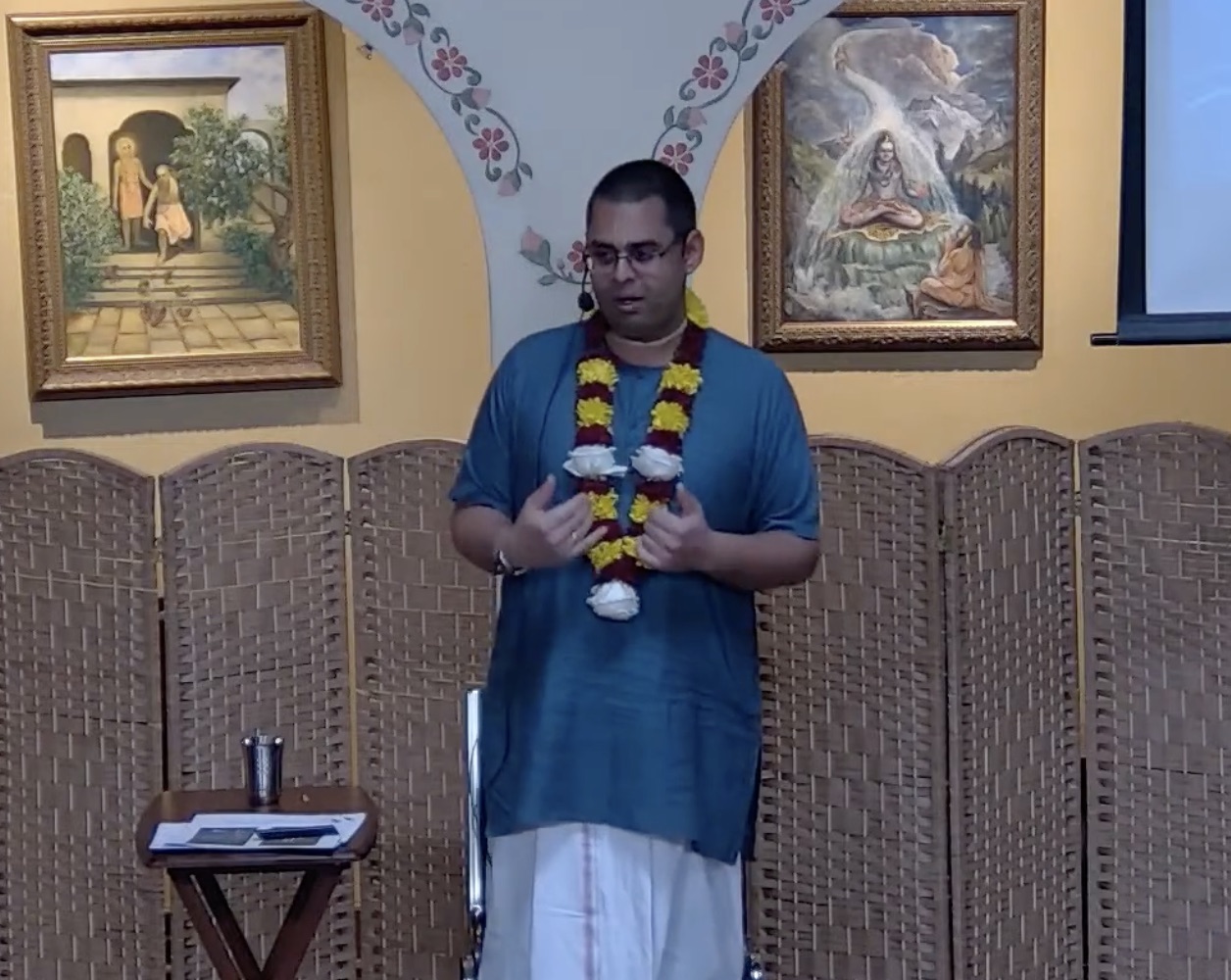
The question of whether to posthumously edit Śrīla Prabhupāda’s published works has become one of the most contentious issues in the contemporary Hare Krishna movement. In a recent presentation, Radhika Ramana Prabhu attempts to justify such revisions by invoking historical precedent, scholarly methodology, and editorial necessity. However, these arguments warrant careful scrutiny and systematic refutation.
This article examines and rebuts the key claims made by Radhika Ramana Prabhu in the following presentation, demonstrating why posthumous editing contradicts fundamental principles of authorial authority and spiritual preservation.
Historical Comparisons: The Goswami Analogy
The Claim: Radhika Ramana Prabhu draws parallels between current editorial efforts and the work of historical figures like the Goswamis, who maintained literary works through critical editing processes. This comparison suggests that scholarly editing of sacred texts has venerable precedent.
The Rebuttal: This comparison commits a category error of the highest order. The Goswamis were pure ācāryas with direct divine realization—their spiritual authority was unquestioned. Modern scholars, regardless of their academic credentials, lack such spiritual qualification. Comparing contemporary editorial committees to the Goswamis inappropriately elevates secular scholarship to the realm of spiritual authority—a conflation that distorts both the nature of the Goswamis’ work and the basis of editorial legitimacy.
Ancient vs. Modern: The Preservation Problem
The Claim: Ancient manuscript preservation faced genuine challenges—hand copying errors, page deterioration, multiple variant readings. Modern editorial challenges, the argument goes, require similar critical methodologies to resolve.
The Rebuttal: This analogy fails on practical grounds. The problems that justified critical editions of ancient texts—physical deterioration, copying errors accumulating over centuries, loss of original manuscripts—simply do not exist for Prabhupāda’s works. We possess his approved published editions, printed with modern technology and preserved in countless copies worldwide. Applying textual criticism designed for fragmentary ancient manuscripts to intact modern publications is methodologically absurd.
Lifetime vs. Posthumous Editing: A False Equivalence
The Claim: The presentation suggests editorial work during an author’s lifetime is essentially equivalent to posthumous editing, provided the same principles and personnel are involved.
The Rebuttal: This fundamentally misunderstands the nature of authorial authority. The difference between editing with the author present and posthumous editing is not one of degree but of kind. When the author lives, they possess absolute veto power—they can approve, reject, or modify any proposed change. After their departure, this direct authority vanishes entirely. No scholarly methodology, however rigorous, can substitute for the author’s living voice saying “yes” or “no.”
Arṣa-prayoga: Preserving Intent or Preserving Words?
The Claim: Radhika Ramana Prabhu frames editing as preserving “authorial intent” through critical analysis, maintaining this upholds the principle of arṣa-prayoga—the preservation of sacred utterance.
The Rebuttal: This fundamentally misrepresents arṣa-prayoga. The principle means preserving the exact words of realized souls, not reconstructing their supposed “intent” through scholarly interpretation. Original words are original words. The attempt to “recover intent” by altering actual words contradicts the very principle being invoked. If we truly respect arṣa-prayoga, we preserve what was said, not what scholars think should have been said.
The Dictation Argument: Composition Method as Editorial License
The Claim: Since Prabhupāda dictated his books rather than writing them directly, special editorial intervention becomes necessary to ensure accuracy.
The Rebuttal: This distinction is irrelevant to the authority of the final text. Whether an author types, writes longhand, or dictates makes no difference if they thoroughly review and approve the published result—which Prabhupāda demonstrably did. He lectured from these books for years, quoted them as authoritative, and distributed them as his definitive teachings. The method of initial composition doesn’t diminish the authority of the approved final product.
Production Complexity as Justification
The Claim: The presentation describes a multi-stage production process—dictation, transcription, editing, typesetting—suggesting this complexity created errors requiring correction.
The Rebuttal: This argument ignores that all this complexity existed during Prabhupāda’s lifetime and culminated in his review and approval. Like an architect who doesn’t personally lay every brick but oversees the entire construction and approves the final building, Prabhupāda supervised the production process and certified the result as his work. The complexity of production doesn’t invalidate the integrity of the approved output.
The “Minimal Involvement” Myth
The Claim: Based on limited extant correspondence about editing details, the speaker suggests Prabhupāda had minimal involvement in the editorial process after dictation.
The Rebuttal: This grossly mischaracterizes Prabhupāda’s priorities and involvement. His books were his most important legacy—the idea that he was cavalier about their content is absurd. The existence of editorial correspondence proves his engagement, not his absence. Numerous first-hand accounts from those who worked with him demonstrate his meticulous attention to his publications. Absence of surviving correspondence about every editorial detail doesn’t prove absence of oversight—it proves only that not every piece of paper was preserved.
The Urgency Argument: Haste Makes Waste?
The Claim: Prabhupāda worked under tremendous urgency to produce books quickly, and this haste presumably led to errors requiring correction.
The Rebuttal: This shameless proposition implies Prabhupāda was careless with his life’s work. His sense of urgency reflected his compassion to deliver Krishna consciousness to a suffering world, not negligence about quality. The suggestion that urgency compromised his books’ integrity insults both his intelligence and his devotion. Many of history’s greatest works were produced under time pressure—urgency focuses attention, it doesn’t necessarily corrupt output.
The “Rascal Editors” Conversation: A Misinterpretation
The Claim: When Prabhupāda complained about “rascal editors,” he was addressing simple editorial mistakes that needed correction.
The Rebuttal: This completely inverts Prabhupāda’s concern. He wasn’t complaining about mistakes but about unauthorized changes—editors altering his words according to their own judgment. The famous “oh sages” versus “O sages” example wasn’t an error in transcription but a deliberate alteration of Prabhupāda’s translation. His complaint was about editorial overreach, not editorial insufficiency. Using this conversation to justify more editing is Orwellian.
Critical Editions Despite Author Approval?
The Claim: Critical editing remains necessary even when we have the author’s approved copy, due to potential errors in the production process.
The Rebuttal: This logic is breathtaking in its arrogance. When we possess the author’s own approved copy, published and used by them for years, claiming that scholars can better determine the author’s intent than the author themselves is both presumptuous and absurd. It subordinates the author’s explicit approval to scholars’ hypothetical reconstructions—inverting the proper hierarchy of authority.
Authors and Intent: Who Knows Better?
The Claim: Authors don’t always clearly express their own intent, necessitating scholarly interpretation to recover what they “really meant.”
The Rebuttal: This is a fundamental fallacy. Who possesses more authority to determine someone’s intent than the person themselves? This problem intensifies when applied to a realized soul whose books were acknowledged as divinely inspired, not products of mental speculation. The claim that scholars can better understand Prabhupāda’s intent than Prabhupāda himself exemplifies academic hubris at its worst.
The Ancient Author Comparison
The Claim: Prabhupāda’s situation resembles that of ancient authors who faced genuine manuscript preservation problems, justifying similar editorial approaches.
The Rebuttal: This inappropriately categorizes Prabhupāda with ancient writers whose works genuinely suffered from preservation problems. Unlike the Mahābhārata or works of Plato, Prabhupāda’s books were carefully published and preserved using modern technology. We have his approved versions, not fragmentary manuscripts reconstructed from scattered sources. The comparison is categorically misleading.
Transcription Difficulties as Ongoing Justification
The Claim: Difficulties transcribing Prabhupāda’s accent and Sanskrit terminology justify contemporary corrections.
The Rebuttal: These production challenges were resolved during Prabhupāda’s lifetime through his review and approval process. Using historical transcription difficulties to justify posthumous changes ignores that the published versions already addressed these concerns with the author’s direct oversight. The problems were solved—by Prabhupāda himself approving the final text.
Early Editors vs. Modern Editors: A Question of Qualification
The Claim: Early editors had limited philosophical understanding; modern editors, with more training and perspective, are better qualified to edit Prabhupāda’s works.
The Rebuttal: This arrogantly assumes current editors surpass those who worked directly under Prabhupāda’s personal guidance. The early editors were trained by Prabhupāda himself, worked under his direct supervision, and received his approval. That relationship conferred authority that later editors, however academically accomplished, cannot claim. Proximity to the source matters more than scholarly credentials acquired decades later.
The Bible and Quran Comparison: Institutional Choice
The Claim: Editing controversies surround texts like the Bible and Quran, where institutional choice among variant editions is normal and accepted.
The Rebuttal: This comparison fails because Prabhupāda’s case is fundamentally different. The Bible and Quran involve multiple sources, centuries of transmission, and numerous variant traditions. Prabhupāda left clear, published books by a single author with explicit instructions that they should serve as textbooks for 10,000 years. We don’t face competing manuscript traditions—we have one approved version and proposals to alter it.
All Versions Equally Effective?
The Claim: All versions of the Bhagavad-gītā produce devotees equally, so textual differences don’t matter much.
The Rebuttal: If versions are functionally equivalent, why make changes at all? This argument defeats itself. Moreover, it contradicts the Vedic principle that specific words create specific effects—śabda-brahman. The original versions produced thousands of full-time devotees and transformed lives worldwide. Their proven effectiveness argues for preservation, not modification.
Changes Don’t Affect Philosophy—So Why Make Them?
The Claim: Since proposed changes don’t affect core philosophy, they’re acceptable.
The Rebuttal: This reveals the circular logic underlying the entire enterprise. If changes don’t affect the philosophy, what’s their purpose? Why alter anything? Every word change modifies the author’s voice, violating arṣa-prayoga regardless of whether it changes philosophical content. The argument simultaneously claims changes are important enough to implement but unimportant enough to justify—a logical contradiction.
Scholarly Methodology as Authorization?
The Claim: Posthumous editing becomes legitimate when conducted through proper scholarly methods and review panels.
The Rebuttal: No amount of scholarly methodology or committee review can authorize changes to an author’s approved work after their death. The author’s final approval supersedes all subsequent scholarly opinions, regardless of academic credentials or review processes. Scholarship may analyze, comment upon, or interpret—but it cannot supersede authorial authority without fundamentally changing the nature of authorship itself.
Conclusion: The Inviolability of the Original
The fundamental issue transcends all these specific arguments. Prabhupāda’s original published works—approved and used by him during his lifetime—represent his complete and authoritative teachings. These books transformed the spiritual landscape of the modern world, producing a global movement of practitioners.
If scholars wish to produce critical editions, variant readings, or interpretive versions, they should do so transparently—clearly marked as scholarly interpretations, not presented as improvements or corrections to the original. Let such editions exist alongside the original, not replace it.
The primary source must remain inviolate, preserving Prabhupāda’s legacy in its intended form for the 10,000 years he envisioned. Anything less dishonors both the author and the authority of his realized wisdom.
The books that changed the world don’t need to be changed by scholars.
This article presents arguments from both sides of an ongoing debate within the Hare Krishna movement regarding the editing of Śrīla Prabhupāda’s published works. Readers are encouraged to study the original works, examine the evidence, and reach their own conclusions about this important issue.