
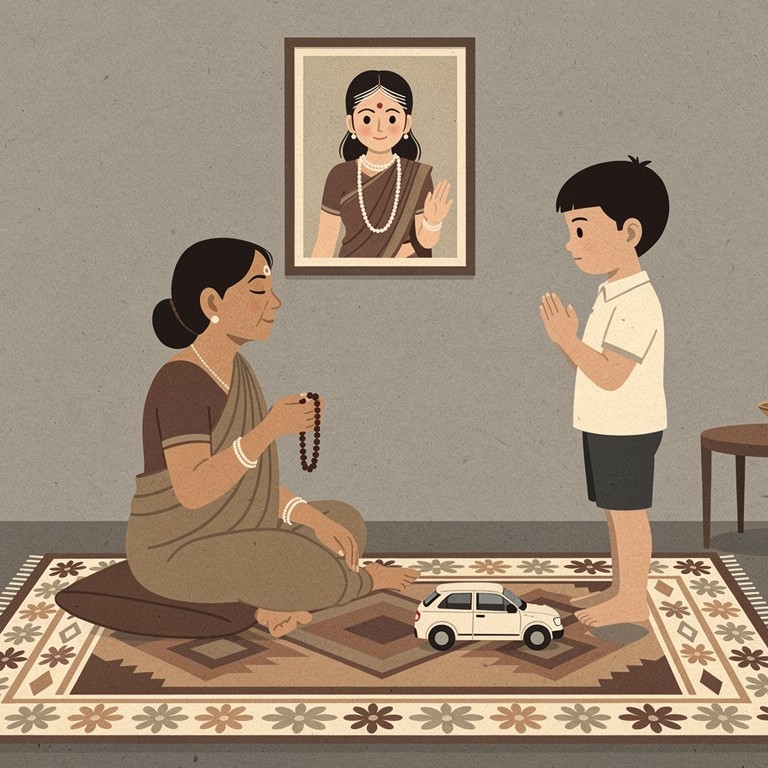
Vrinda had been preparing for the home program for two weeks. Her guru was coming, and she wanted everything right. The flowers. The fruit. The cushions. Her son Madhav was twelve, and she had spent the morning going over his part with him. “Just one verse from the second chapter. Anyone you like. And finish your eight rounds before they arrive.”
He had stood in the doorway and asked if he could play his Switch later, if he did everything she asked.
The words came out before she could shape them. “Finish your duties without complaining first. Then you can play with the Switch, but no shooting games today, please.”
He nodded. He took the beads. He went to his room.
By the time the guests arrived he had completed the rounds and memorized the verse. When her guru called on him during Q&A, Madhav stood up, hands folded, and recited it cleanly. The room beamed. Vrinda’s husband caught her eye across the cushions and they smiled. This is what a devotee son looks like, the smile said. This is what a devotee home looks like.
After the guests left, she watched Madhav’s face soften, exhausted in a way she did not understand, and she let him have an hour on the Switch. Not the shooting games. The other ones. He played silently, and she sat in the next room feeling, for the first time all day, like a good mother.
He had done everything asked of him, and he was not happy. The rounds were supposed to make him happy. The verse was supposed to make him happy. Being the boy the room wanted was supposed to feel like something, and what it actually felt like was flat and tired and far away.
He could not say so. I did all of it and I feel empty was not a sentence he was allowed. It would sound like ingratitude. It would sound like maya. So he said nothing, kept the flatness where nobody could see it, and began, very quietly, to suspect that the fault was in him.
By every measure the community could see, he was a good devotee son. Nobody thought to ask whether the boy who did all of it was really him. Neither did he.
What Madhav Already Knows
He is twelve. He has been learning this since he was five.
When he does well, the love is warm. When he does not, the love goes quiet.
Nobody ever sat him down and told him this. He worked it out the way children work things out, without knowing he was doing it. She is never harsh with him. There is nothing in his house to be afraid of. There is only, always, something to earn. He knows which mornings get the warm voice and which get the polite one. The part of him that should be busy being twelve is busy being good instead. There are boys at school whose parents simply like them, without their having done anything to deserve it. It has never crossed his mind that a boy could be loved on a day when he had nothing to show for himself.
This is not the worst kind of childhood. It is gentle on the surface. The cruelty in it is so quiet that for a long time he will doubt it was cruelty at all.
She Does Love Him
Say any of this to the devotee parent and the answer comes back fast. I love my child. Of course I love my child. What are you talking about. And it is true. The love is real. It is large. It is not in question.
That is not the claim. The claim is deeper and harder to see. It is that the love has a dial, and the dial moves. She loves him on the morning he forgets the verse. She loves him more on the morning he recites it. The gap between those two mornings is small enough that she has never had to look at it directly, and exactly large enough that he has spent his whole childhood learning to close it.
She measures her love by how constant it is, and it is constant. He measures it by how it moves, and it moves. Both of them are right. That is why they will remember the same childhood in two completely different ways. She remembers loving him the whole time, because she did. He remembers earning the warmth, because he had to.
Bhakti Inverted
What is being inverted in Vrinda’s home is the heart of bhakti itself.
The Srimad Bhagavatam 1.2.6 names the standard:
“The supreme occupation [dharma] for all humanity is that by which men can attain to loving devotional service unto the transcendent Lord. Such devotional service must be unmotivated and uninterrupted to completely satisfy the self.”
Ahaituki. Unmotivated. Causeless. Without conditions. The whole tradition rests on the proposition that the highest love is offered without a reason and received without one. The whole tradition rests on the proposition that this is how Krishna also loves us in return.
The Bhagavad-gita 4.11 says it directly:
“As all surrender unto Me, I reward them accordingly. Everyone follows My path in all respects, O son of Pritha.”
Krishna meets the soul where the soul is. There is no quota. No performance threshold. He does not require the rounds to be at sixteen before He responds. He does not require the dress to be correct, the Sanskrit to be fluent, the pose to be unmoved. He responds to whatever measure of turning has happened, in whatever form it has taken.
The devotee parent who ties their affection to rounds, to verses, to attendance, to posture, to the right kind of friends, is running an emotional economy Krishna Himself does not run. That is not a small problem. The child raised inside that economy does not just learn that his parents love him conditionally. He learns that Krishna loves him conditionally. His relationship with the divine inherits the shape of his relationship with the parent. He spends years, sometimes decades, trying to perform his way into a love that was meant to arrive without his having to earn it.
The philosophy he is being given is supposed to be the cure for that anxiety. In his home, it has become the cause of it.
Two People in the Room
Vrinda and Madhav are not the only people in their living room. There are two other figures present, neither of whom either of them can see. The first is the Madhav who exists under the practiced one. The second is the Vrinda who was once a compliant child herself, in a different house, thirty years ago.
The Gifted Child
Alice Miller used the word “gifted” not for IQ but for emotional perceptiveness. The gifted child is the one who works out, very early and without ever being told, exactly what his parents most hope he will be.
In the devotee home, he works out that a verse recited well is worth more than a verse forgotten, and that being found chanting is worth more than being found playing. He learns, before he has language for any of it, which version of himself the house is glad to see.
So he becomes that version. He recites well. He sits still. He learns the names of the deities and the order of the offerings and how to hold himself at the right times. He becomes what the family is most pleased to see. The praise he receives for being “naturally devotional” is itself the evidence that the system is working. He has found the pose that brings the warmth, and so he holds it, and holds it, and holds it.
What he cannot do is the part of himself the family had no place for. He cannot rage at his sister. He cannot be afraid of the dark in the way ordinary children are afraid of the dark. He cannot dislike the prasadam his mother cooked. He cannot ask whether the saint his parents quote so often was a kind man. The unwelcome parts of him do not vanish. They go underneath. The trauma literature has names for what he becomes. Winnicott called it a false self, layered over the real one. Pete Walker calls the survival pattern fawning, the chronic placation trained into the nervous system before the child has chosen anything for himself.
The irony will not be lost on him later. The books that finally explain his own childhood to him are the ones his parents waved away without ever opening. Mundane psychology. Mental speculation. Written by meat eaters. He will recognize himself on a page his father would not have allowed in the house, and he will have to decide what to do with the fact that it helped.
By twelve he is the model devotee child. By fifteen, sometimes earlier, the layer cracks. He often leaves not because the philosophy was false, but because he cannot tell anymore which part of him chose any of it. The performing self has eaten the real one, and there is no one left underneath who knows what it would be to want Krishna for his own reasons.
Some never crack. They become the next generation of devotee parents, pleasant and steady on the outside, governed underneath by the same anxious instrument that learned long ago to read the room and produce.
Love That Does Not Measure
The parent who measures love in rounds was once measured the same way. They are not choosing to wound their child. They are handing on the only shape of love anyone ever handed them, and calling it devotion because that is the word they were given for it.
None of this requires an advanced stage. Loving a child without keeping score is not a spiritual attainment. It is the ordinary thing the parents of the boys at Madhav’s school manage without thinking about it at all, and it is exactly what the philosophy was supposed to protect.
Some who read this will recognize the house. The cold beside the altar. The face that flattened because a round was missed. Krishna is not that cold, and the philosophy is not that cold. The warmth you kept reaching for was never your weakness. It was your soul recognizing what a house is supposed to feel like.
If you are a parent, love your children before they have done anything to deserve it. If you are the child, you are allowed to come back to the philosophy slowly, on your own terms, or to set it down a while and let it find you again. The test is one sentence. Does my philosophy make me more loving, or less? If less, it is being misused. The mark of a Vaishnava is a soft heart, not a hard one.
The Same Evening, Differently
Imagine the same evening. Same recitation. Same room of beaming guests. Different ending.
After the guests leave, Vrinda sits down beside her son on the couch where the game is paused on the screen. She does not ask if he completed his duties first. She does not catalogue the morning’s small infractions. She watches him play for a few minutes, asks him what is happening in the level, lets him explain. She lets it be his thing.
When he finally turns the game off, on his own, she puts a hand on his head and tells him she is glad he is her son. Not because of the recitation. Just because.
He looks up at her. She is not measuring. He does not have language for what he feels, but his shoulders drop a quarter of an inch, and the boy underneath the practiced one, the boy she has never seen, sets down the beads and goes outside to play.
The philosophy has not changed. Krishna’s love was always like this. The mother has only just begun to let her own become the shape it was always meant to be.