
How a dying man’s last words revealed what he had been worshipping all along.
There is a moment, in every life given to a cause, when the cause finally speaks back. It speaks in the grammar of farewell — in what a man reaches for when the body is failing and the mind knows it. Not what he has rehearsed. Not what the position demands. What comes out, unbidden, when he is looking at the door.
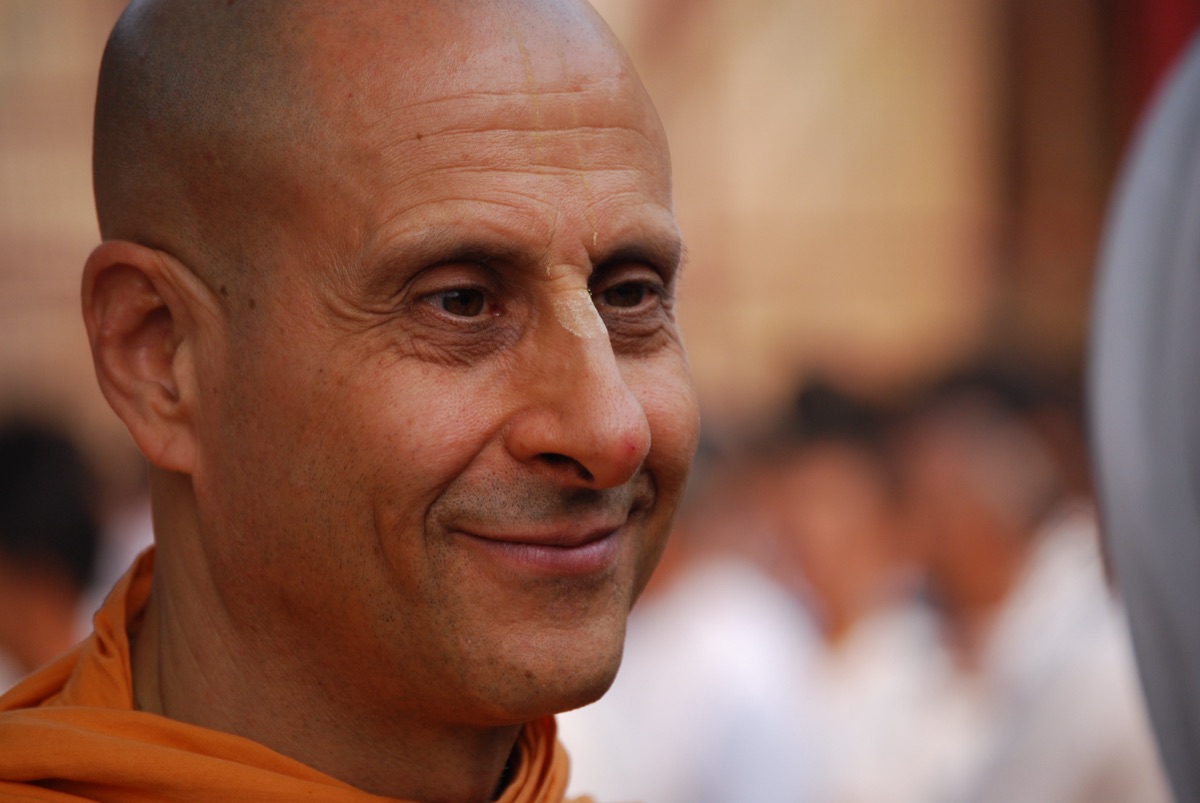
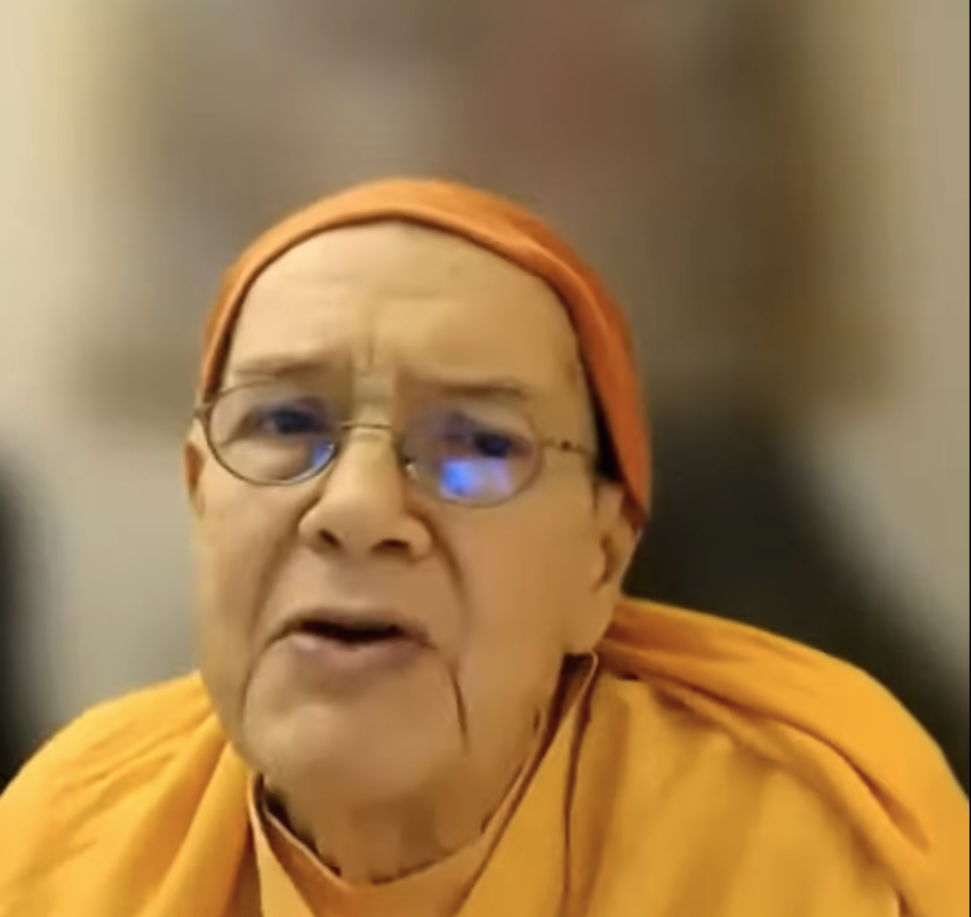
Badrinarayan Swami is looking at the door. He knows it. He says so. And what he reaches for, in that final minute of recorded counsel to the next generation, is this:
“But I want to say one other thing that I’m an old man. I am not in good health. I, you know, who knows how much longer I’m going to last. And I’ve given my entire life as much as I have the ability to praise ISKCON. And it makes me so happy. I have confidence when I see devotees like you. This is an intelligent mature, you put aside your personal I mean we all have some desires but you have given your life to Maha Prabhu’s mission and serving the devotees. I can leave this world confident that that which I’ve given my entire life to is in good hands. It’s got devotees like you. You’re the… you’re carrying on. It’s in your hands and I’m sure that you will do a better job than we did. So, thank you very much. Hare Krishna.”
One minute. Perhaps the last recorded minute. And the word that organizes the whole valediction, the word around which every sentence orbits, is ISKCON.
Not Krishna. Not Prabhupada. Not the holy name.
ISKCON.
The Two Farewells
In 1963, Pope John XXIII lay dying in the Apostolic Palace. He had convened the Second Vatican Council — the most consequential act of Catholic reform in four centuries — and he would not live to see its conclusion. The men around his bed recorded what he said. He spoke of Christ. He spoke of the Church as the mystical body, not the administrative one. He recited the prayers of his childhood. He asked for mercy.
Thirteen years earlier, Juan Peron addressed the Argentine nation before his first exile. He spoke of the movement. He spoke of the organization. He spoke of what he had built, who would carry it forward, and how confident he was in the hands that would hold it. The nation, the cause, the man — fused into a single institutional pronoun.
One man was preparing to meet God. The other was preparing to leave the office.
The difference is not in what they said about themselves. It is in what they did not say about anything else.
The Object of Devotion
Listen to the architecture of the farewell. The sentence at its center: “I’ve given my entire life as much as I have the ability to to praise ISKCON.” The object of a lifetime’s devotion, named plainly, in a man’s own voice, with death in the room.
The object is the institution.
In Gaudiya Vaishnava theology, the chain of transmission is precise. The disciple surrenders to the guru. The guru connects him to the parampara. The parampara transmits Krishna. At no point in this chain does a management corporation appear. ISKCON, in Prabhupada’s own description, was an instrument — a vehicle for distributing the holy name across the world. The vehicle is not the destination. The printing press is not the book.
Yet here, at the end, the instrument has become the object. “I’ve given my entire life to praise ISKCON.” Not: I have given my life to serve my spiritual master. Not: I have tried, however imperfectly, to distribute the mercy of Lord Chaitanya. The referent is the organization. And when he turns to legacy — “that which I’ve given my entire life to is in good hands” — the that which points, again, to the same address. A registered body. A corporate entity. A structure with committees and budgets and zones.
Prabhupada’s name does not appear in the speech. Not once. Not in passing. Not as a source of instruction, not as the object of gratitude, not as the master whose mercy made everything possible. The guru through whom this man received initiation, through whom the entire tradition flowed to him, is absent from his farewell to the world.
This is not a minor omission.
The Grammar of the Self
There is a pattern in the speech worth examining — not because self-reference is inherently wrong (a dying man is entitled to speak of his own life), but because of what it displaces.
I’m an old man. I am not in good health. I’ve given my entire life. It makes me so happy. I have confidence. I can leave this world confident. That which I’ve given my entire life to.
Seven first-person constructions in sixty seconds. Each one concerns his satisfaction, his legacy, his sense of completion. The emotional center of the farewell is the speaker himself.
Place beside it what Prabhupada spoke about when he was dying in Vrindavan in November 1977. His body was failing more completely than any of his disciples had imagined possible. He could barely whisper. And what came out was: Are they chanting their rounds? Are the books being distributed? Have the devotees been fed? He asked about the printing of the Tenth Canto. He worried about the standard of deity worship. He asked to be carried on parikrama around Vrindavan so he could leave his body in the dust of the dhama.
Not once, in weeks of recorded final conversations, did Prabhupada review his own career. Not once did he say, “I can leave this world confident in my legacy.” The lens was pointed outward — toward Krishna, toward the mission’s content, toward the disciples’ spiritual practices.
The man was transparent. The light passed through.
The Shape of Humility
“I’m sure that you will do a better job than we did.”
The sentence has the shape of humility. It has the contours of self-effacement. But press on it and notice what is not inside.
What job? Better in what way? What, specifically, did “we” do that needs improving?
The Hare Krishna movement’s institutional history includes the systematic abuse of children in its gurukula schools — abuse so extensive it produced one of the largest civil settlements in American religious history. It includes the documented falldown of almost all the originally self-appointed gurus, some into criminal conduct. It includes financial scandals, the unresolved poisoning allegations surrounding Prabhupada’s final days, and five decades of contested questions about the founder’s instructions on initiations after his departure.
“I’m sure you will do a better job than we did” names none of this. It floats above the wreckage like a banner that reads Under New Management. It is the language of corporate succession — the outgoing CEO assuring shareholders that the transition will be smooth — not the language of a Vaishnava confronting his own failures before God.
Vaishnava humility has a specific texture. It names the offense. It begs forgiveness from those who were harmed. It trembles before the judgment seat. Bhaktivinoda Thakura, in his final years, wrote that he was the most fallen, the most unqualified, and that only the causeless mercy of Nityananda could save him.
He did not say, “The Nama Hatta is in good hands and you’ll do better than I did.”
What the Dying Reach For
Raghunatha Dasa Goswami spent the last decades of his life at Radha Kunda. He ate almost nothing. He slept almost never. He bowed hundreds of times a day. And when he wrote — when he put into words what lived inside him at the end — he did not write about the Gaudiya institution. He did not assess whether the sampradaya was in good hands. He wrote Vilapa Kusumanjali — a garland of prayers so saturated with longing for Radha and Krishna that the words themselves seem to weep. He wrote of his guru, Svarupa Damodara. He wrote of the mercy of Lord Chaitanya. He wrote of his own unworthiness.
The Chaitanya Charitamrita records the principle: diksha-kale bhakta kare atma-samarpana — “at the time of initiation, the devotee surrenders himself to the guru who represents Krishna” (CC Madhya 15.108). The guru’s function, in Prabhupada’s own repeated formulation, is to be a transparent via medium. Transparent. The light passes through. One sees Krishna on the other side — not the medium itself, and certainly not the medium’s institution.
When a man is dying, the transparency is tested for the last time. What comes through? What has actually been living inside the form of devotion all these years?
The Door
A man stands at the threshold. Behind him, half a century of service, thousands of lectures, a life lived inside the walls of a spiritual institution. Ahead of him, whatever comes next — the accounting that every tradition, in its own language, promises the soul.
He has one minute. He uses it to say that he is happy with what he built, confident it will continue, and sure the next generation will do fine.
He does not mention his spiritual master’s name. He does not quote a single verse of scripture. He does not cry out for the mercy of Krishna. He does not chant the holy name — except as a sign-off, the way a corporate letter ends with Best regards.
He praised ISKCON. He praised it with his whole life, he said.
The door opens. And on the other side, it is not ISKCON that is waiting.
Source: HH Badrinarayan Swami’s Final Message to Future Generations Date: February 27, 2026