
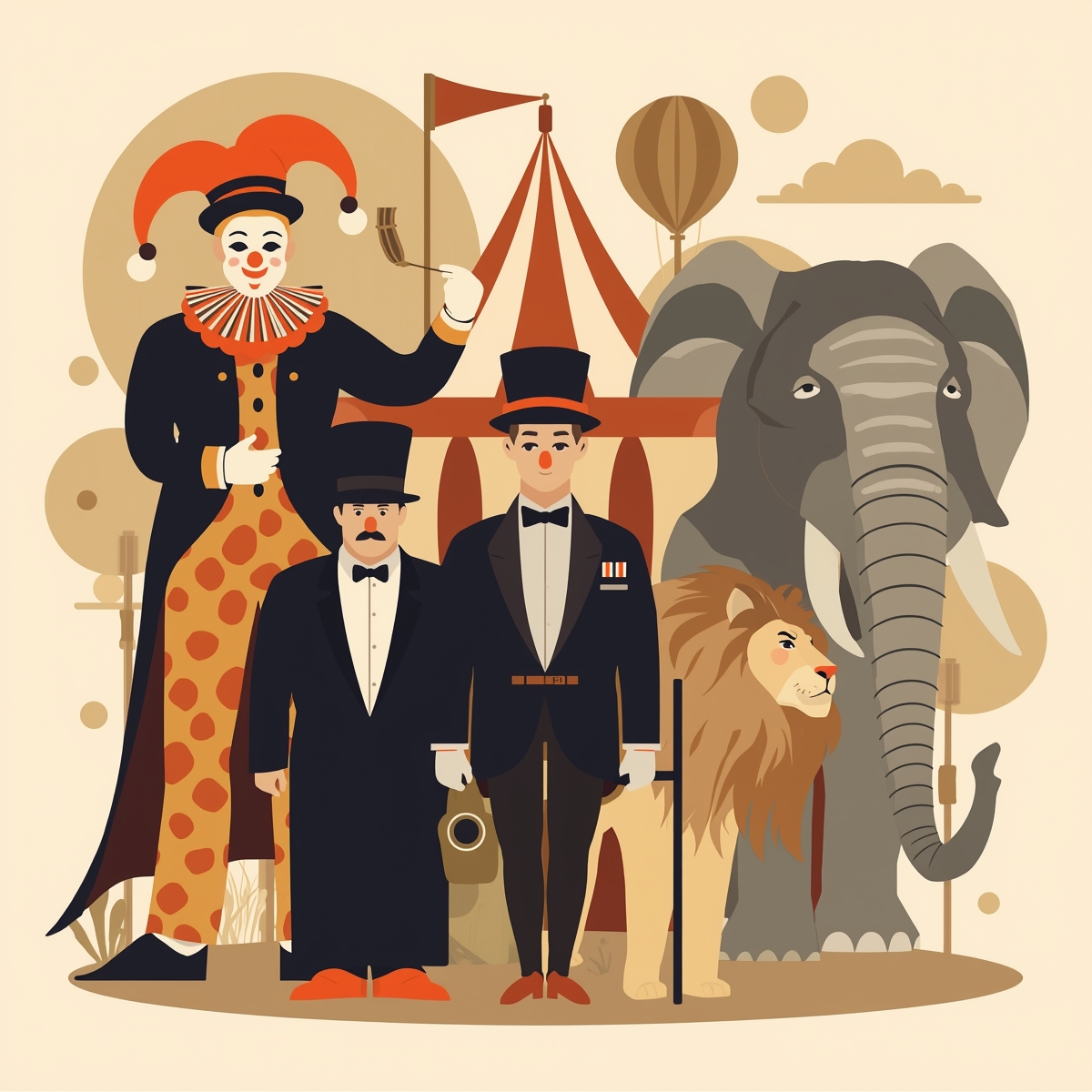
How a spiritual institution became the greatest show on earth.
There was a time when this was a hospital.
A place where the sick of soul arrived and left cured. Where a single physician — one man, with clean hands and a transparent heart — administered the medicine of the Holy Name without charging admission, without set design, without fanfare. The patients came because they were dying. The doctor came because he had something that worked. The transaction was simple: you surrender, you get cured. No tickets. No intermission. No applause.
But the physician left. And those who inherited the building looked around and decided that a hospital was not profitable. Healing is slow. Healing is quiet. Healing does not fill stadiums or generate annual reports. So they tore out the beds, swept away the medicine, hung colored lights from the ceiling, and opened the doors under a new name.
They called it a circus.
The Cast
Every circus requires a cast. Not actors — actors know they are pretending. A circus requires performers who have forgotten the difference between the act and the real, who have lived inside their costumes so long that the costume has become the skin.
The dwarf occupies center ring. He jumps and tumbles and does backflips, each one designed to make him feel tall. The dwarf was sold to the circus by his own family when he was a child, on the promise that the circus would make something of him. It made him a performer. Whether it made him a good one is irrelevant — in this circus, no one in the audience can tell the difference between a good act and a bad one. What matters is that the dwarf keeps jumping. He keeps jumping because if he stops, he will have to stand still, and if he stands still, everyone will see how short he is.
The strongman lifts barbells painted black. The audience applauds every time he grunts. No one has walked up to check whether the weights are real. No one will. The grunt is convincing. The paint is fresh. That is enough.
The bearded lady holds a special place on the marquee. She is presented as the great innovation — “For the first time in circus history!” — a novelty act designed to prove that the circus is progressive. The men in the audience, instead of asking whether the act makes sense, applaud on command, because the ringmaster told them that applause is spiritual advancement.
The clown appears precisely on cue, every time the brass section hits its note. Painted smile, red nose, enormous shoes. He has nothing to say, but he says it with great ceremony. When the audience stops laughing, the clown grows serious and quotes a Sanskrit verse. Everyone laughs again — but now with devotion.
The storyteller sits on a gilded stool and narrates tales that sound like scripture but smell like invention. The audience weeps. The storyteller weeps too. No one knows what they are weeping about, but weeping together is part of the show.
The fire-eater spits flames from his mouth while shouting that the world is ending, that tradition is collapsing, that everything was better before. The audience recoils. The fire-eater feels important. At the end of his number, he sits down to eat at the same table as the people he has just denounced.
The animal tamer has his own pastoral farm — cows, calves, green pastures, the kind of thing you see in tourism brochures. He talks about animal protection while the circus itself runs on the same dynamics as a corporate slaughterhouse. But the photographs are beautiful.
The Trapeze
High above, under the peak of the tent, the trapeze artists swing.
These are the New Age performers. The ones who blend kirtan with yoga in bikinis, mantra with marketing, and devotion with influencer lifestyle. They do somersaults without a net — because the net was tradition, and they cut it long ago to make the act more exciting. The audience gasps. The trapeze artists smile for the camera. One of them is livestreaming.
In any other circus, the absence of a net would be recognized as recklessness. Here it is celebrated as innovation.
The Magician
The magician is the headliner.
He enters in cape and top hat, and he makes things disappear: the truth, the uncomfortable questions, the testimonies of abuse, the history. In their place appear white doves, beatific smiles, and self-help books disguised as spirituality. The audience sits open-mouthed. The magician takes a bow. No one asks where the disappeared things went.
The greatest trick the magician ever performed was convincing the audience that the things he made vanish were never there to begin with.
The Orchestra
The trumpeter plays the same melody over and over. It does not matter that he is out of tune. The circus needs background music so that silence does not give the audience time to think. Silence is dangerous in a circus. Silence is where questions form. The brass section exists to ensure that no question fully crystallizes before the next act begins.
The Dancers
A legion of can-can dancers — mostly imported from the East — file in with their worn-out feathers, their old and threadbare dresses, their smudged makeup trying to conceal the age on their faces. They dance with forced energy. They smile with clenched teeth. The audience applauds because that is what one does when the dancers come out.
No one notices the holes in the costumes. No one notices the exhaustion behind the smiles. The lighting is designed to hide both.
The Beasts
In the cages at the back of the tent are the animals.
The elephant walks in circles because it knows nothing else. It was born in the circus. The circle is the only geography it has ever mapped.
The seal claps its flippers every time someone throws it a fish. It is the perfect devotee: obedient, loud, and entirely dependent on whoever feeds it.
The tigers — the predators, the abusers, the ones who prey on the vulnerable — prowl their cages, waiting for someone to wander too close. Every now and then, they succeed. The circus issues a press release stating that the victim “did not follow safety protocol.”
The lion is old and toothless. The tamer puts his head in the lion’s mouth. The audience holds its breath. But the real danger was never the lion. The tamer’s mouth is far more dangerous than the lion’s jaws.
The Box Office
The governing board runs the box office. They do not perform. They do not jump, they do not breathe fire, they do not tell stories. But they control the door. Without them, no one enters. And without anyone entering, there is no circus.
Behind the curtain, the enforcers do the collection work. They do not appear on the marquee. They are not in any of the photographs. But they are the ones who make sure the money flows, that no one asks questions about the accounts, and that anyone who complains disappears from the audience without anyone noticing.
The Popcorn Vendor
While the show continues, the popcorn vendor — the temple president, the local manager, the man with the cash register — walks the aisles profiting from the spectacle. He does not care who performs or who suffers. He only cares that the show does not stop, because as long as there is a show, there is business.
The Audience
And then there is the audience.
Hypnotized. Unblinking. Seated in perfect rows with their eyes fixed on the ring.
They are the followers of the cult of personality. The ones who applaud the clown, weep with the storyteller, tremble at the fire-eater, and marvel at the magician. They are the ones who actually sustain the circus. They pay for the ticket. They pay for the seat. They pay for the popcorn. They pay for the photographs with the clowns — because the clowns love having their photographs taken with the public.
The audience is composed of the most naive — like children who see colored lights and believe they are in a magical world. And the rest — the parents — come because the children like it. And in the end, everyone is kidnapped by the spectacle. No one stands up. No one leaves. The door is open, but no one sees it.
The Costumes
The saffron robes belong to the principal clowns. They wear them so the audience knows who commands the ring. The color no longer signifies renunciation. It signifies hierarchy. It means: “I am part of the cast and you are part of the audience. You pay, I perform.”
In the tradition this circus claims to represent, saffron meant the opposite. It meant: I own nothing. I claim nothing. I am no one. The cloth was a flag of surrender, not a uniform of rank.
The circus kept the color. It discarded the meaning.
The Farce
Everything is fake.
The sets are cardboard. The smiles are paint. The tears are glycerine. The verses are from memory, not from realization. The embraces are protocol. The humility is wardrobe.
It is a farce. A spectacle. An entertainment.
And while the audience watches the show with mouths agape, the human form of life slips away. Second by second. Breath by breath. The one form of existence that permits the question “Who am I?” and provides the means to answer it — spent watching clowns.
This is why those who mount the show bear such enormous responsibility. And this is why their destination is so grave. Because they do not merely waste their own human birth — they cause others to waste theirs. And people allow it, because people are looking for ways to distract themselves from the misery that lives inside every individual. Any circus will do. This one carries the added distinction of calling itself “spiritual,” which makes it twice as dangerous.
A secular circus wastes your evening. A spiritual circus wastes your life.
The Final Act
At the end of the show, when the lights go down and the music stops, the dwarf comes out one last time. He takes a final leap. The highest leap he can manage — to feel, for one instant, that he has stature.
The audience applauds.
The lights come on.
And tomorrow, the same show. The same circus. The same clowns.
The show must go on.