
Gauranga das had given Krishna everything. Forty years of book distribution, ten thousand mornings of walking up to strangers in parking lots and airports with Prabhupada’s books under his arm. He had raised funds, trained crews, weathered the politics of three different temples. And now, in his sixties, he had started his masterwork: a campaign to place Prabhupada’s books in every public library, school, and university in the region, standing orders and donated sets that would sit on shelves for generations, so that long after he was gone some student would pull down the Bhagavad-gītā As It Is and never be the same.
It was a beautiful vision. It was real service. And one afternoon, explaining why he had quietly stopped chanting his rounds, he said the sentence that should freeze the blood of every serious devotee who has ever been busy:
“Honestly, the rounds feel like a waste of time. My mind is racing with so much service to do. In the two hours I spend chanting, I could accomplish so much.”
He was not a fallen man. He was not lazy, not faithless, not a fringe character drifting away from the movement. He was one of the most productive devotees you could meet, a man who had personally placed more of Prabhupada’s books than most temples distribute in a decade. And he was standing at the edge of a cliff he could not see, because the cliff was made entirely of good works.
The heresy no one calls a heresy
We know how to recognize the obvious falldowns. The devotee who breaks the regulative principles. The one who stops coming to the temple. The one who loses faith and walks away. We have categories for these, and sermons.
We have almost no language for the falldown that looks like advancement.
The devotee who chants less and less, not because he is attached to sense gratification, but because he is so absorbed in serving Krishna that the holy name starts to feel like an interruption. He is not skipping rounds to watch television. He is skipping rounds to build something glorious for the mission. From the outside, and often from the inside, this looks like surrender. It looks like the highest sacrifice, a man so dedicated he has no time even to chant.
It is the most respectable form of spiritual death available to a Vaishnava, and precisely because it wears the robes of devotion, no one sounds the alarm. The community praises the output. The man collects the praise and reinvests it in more output. The beads gather dust in the bag. And the question no one asks, least of all the busy man himself, is the simple one: when did serving Krishna become a reason to stop being with Krishna?
How the best devotees fall
This pattern does not hunt the weak. It hunts the capable, the visionary, the ones who can actually get things done. Watch how it takes them.
The temple president spends his day managing the Deities’ house. He arranges the worship, raises the money, fixes the roof, settles the disputes between the pujaris. He is the busiest devotee in the building. And one morning he realizes he has not actually stood before the Deities and looked at Them, as a person looks at a beloved, in months. He has been managing the Lord’s affairs and has stopped visiting the Lord.
The development director spends his day raising the money the mission runs on. Every rupee he brings in becomes a meal, a book, a festival. The chanting, which raises nothing and fills no spreadsheet, slowly becomes the thing he does when there is time left over, and there is never time left over.
The distributor, like Gauranga, measures his spiritual life in scores and shelves. The numbers are real and the books do real good. He pours himself into a campaign so obviously valuable that it silences every objection. Who could argue with putting Prabhupada’s books in front of a million students? The campaign becomes the justification for everything it crowds out, including the rounds. The leaves grow magnificent. No one is watering the root.
Notice the common thread. In each case the person has not chosen sense gratification over Krishna. He has chosen work for Krishna over attention to Krishna, and he has been taught his whole devotional life that work for Krishna is the goal. So the substitution feels not like a fall but like a promotion. That is what makes it so difficult to see and so dangerous to live inside.
When doing quietly replaces being
The mind is the mechanism. Arjuna named the problem directly to Krishna:
“For the mind is restless, turbulent, obstinate and very strong, O Kṛṣṇa, and to subdue it, I think, is more difficult than controlling the wind.” — Bhagavad-gītā 6.34
A restless mind cannot sit still with a person. It can only do things. So when such a mind is given to Krishna’s service, it does not become peaceful. It becomes a restless mind with a holy job. It generates an endless stream of tasks, plans, improvements, and emergencies, all of them genuinely about Krishna, and it experiences any demand to simply sit and chant as unbearable inactivity.
This is why the busy devotee says chanting is a waste of time. Chanting is the one activity in his day that produces nothing he can point to. No score, no completed project, no praise. It asks him to stop accomplishing and simply be present with Krishna through Krishna’s name. And a mind addicted to accomplishment reads presence as waste.
There is a deeper layer, and it must be named gently because it is painful. Over decades, the doing can quietly become about the doer. The service is real, but somewhere underneath, the satisfaction has shifted from “I am serving Krishna” to “Look what I am building.” The ego does not announce itself. It simply makes the visible, measurable, praiseworthy work feel infinitely more important than the invisible, unmeasurable, unwitnessed work of chanting in an empty room before dawn. When a man tells you that being alone with God is a waste of his time, the question to ask with great tenderness is: who, exactly, is it whose time is too valuable for God?
What the name actually is
Here the philosophy is not vague, and it does not bend. Lord Caitanya built His entire movement on a single instruction, repeated for emphasis:
“In this Age of Kali there is no other means, no other means, no other means for self-realization than chanting the holy name, chanting the holy name, chanting the holy name of Lord Hari.” — Śrī Caitanya-caritāmṛta, Ādi-līlā 17.21
Three times He says there is no other means. Nāsty eva, nāsty eva, nāsty eva. He repeated it three times because He knew that intelligent, capable, devoted men would each invent a private exception, a reason that their particular service was the real work and the chanting was optional. The holy name is not the preparation for devotional service. The holy name is not the warm-up before the important activity begins. In this age, the holy name is the activity. It is the yuga-dharma, the prescribed means of God-realization for our entire epoch.
And the name is not a symbol pointing at Krishna. The name is Krishna, present on the tongue, nondifferent from Him. Placing His books into a thousand hands is magnificent service to Krishna’s words. Chanting His name is direct, personal association with Krishna’s self. To prefer the first and dismiss the second is to choose the photograph over the person standing in the room.
As for the fear that chanting drains time away from all the other service, the Bhāgavatam dismantles it completely:
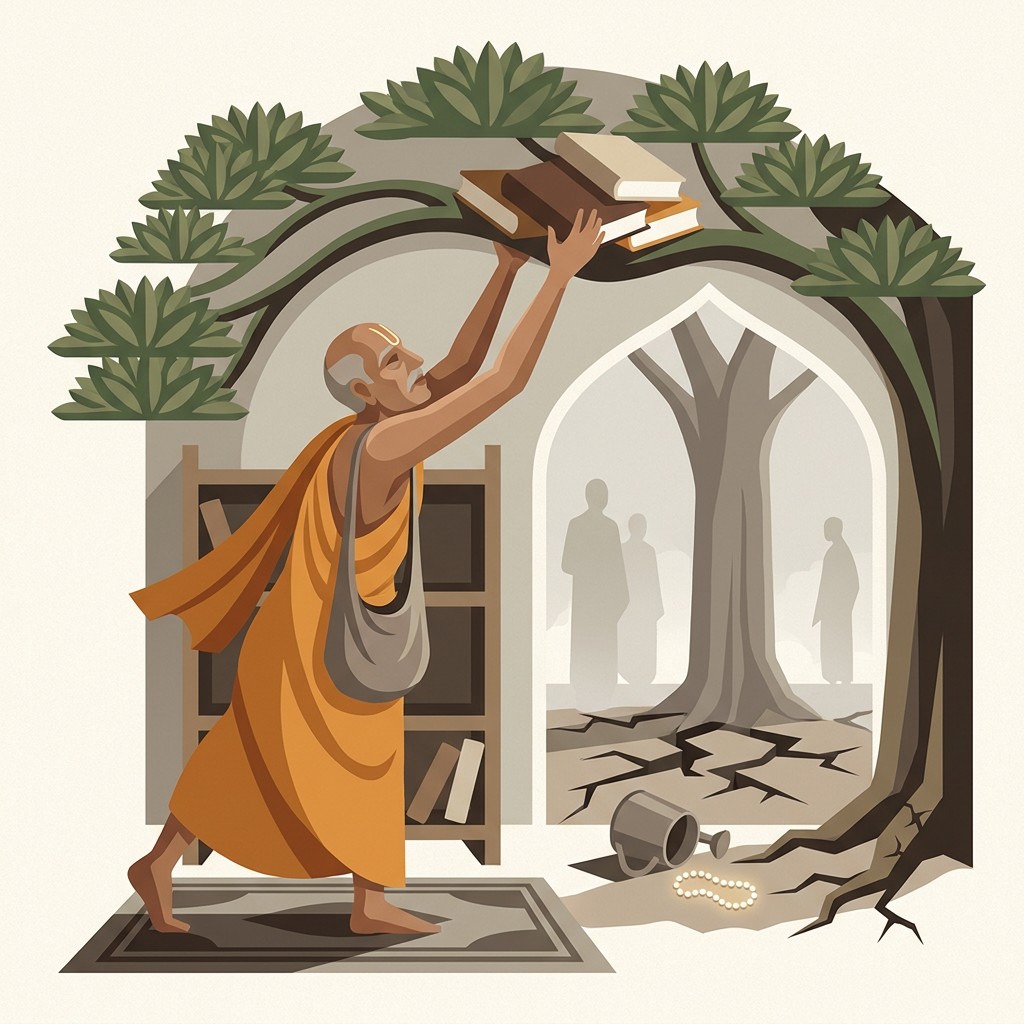
“As pouring water on the root of a tree energizes the trunk, branches, twigs and everything else, and as supplying food to the stomach enlivens the senses and limbs of the body, simply worshiping the Supreme Personality of Godhead through devotional service automatically satisfies the demigods, who are parts of that Supreme Personality.” — Śrīmad-Bhāgavatam 4.31.14
Read what it says about priority. The books distributed, the libraries stocked, the temples raised, all the visible service, these are the trunk and branches and spreading leaves. The chanting is the watering of the root. The busy devotee proposes to take the hours he spends at the root and spend them instead on the leaves, reasoning that the leaves are where the real growth shows. He has the botany exactly backward. Stop watering the root and the leaves stay green for a season on the water already in the system. Then they do not.
The beautiful dead tree
This is the consequence, and it arrives slowly enough that the victim never connects it to the cause.
For the first few years, nothing seems wrong. The service continues, the projects ship, the man on reduced or abandoned chanting feels fine, even energized. The tree is living on stored water. But the holy name was the only thing cleansing the heart, and with that cleansing suspended, the subtle contaminations return unopposed. The work grows harder and more joyless. Relationships with other devotees turn brittle and political. The taste for everything spiritual dries up, and the man, having already concluded that chanting is a waste, has thrown away the one medicine that treats exactly this disease.
Srila Rupa Gosvami described that dryness with surgical precision:
“The holy name, character, pastimes and activities of Lord Kṛṣṇa are all transcendentally sweet like sugar candy. Although the tongue of one afflicted by the jaundice of avidyā [ignorance] cannot taste anything sweet, it is wonderful that simply by carefully chanting these sweet names every day, a natural relish awakens within his tongue, and his disease is gradually destroyed at the root.” — Śrī Upadeśāmṛta (The Nectar of Instruction), Text 7
The dryness is not a verdict that your devotion was fake. It is jaundice on the tongue. The candy never stopped being sweet. The disease made it taste like nothing, and the cure for the disease is the very candy that now tastes like nothing, taken daily with care. The busy devotee, tasting nothing, concludes the candy is worthless and stops taking it. So the jaundice deepens, the dryness spreads, and one season he looks up at the magnificent structure of his devotional career and finds it is a tall, intricate, beautifully engineered dead tree, and he cannot understand what happened, because he was so busy the entire time it was dying.
Watering the root
If you recognize yourself in any of this, understand first what is not being said. No one is telling you to stop serving. No one is diminishing your work. The books are glorious. Every one you placed will outlive you and do good you will never see. The error is not that you served too much. The error is a single false sentence you began to believe: that being with Krishna through His name is a waste of the time you owe to working for Him.
Correcting it does not require you to abandon a single project. It requires you to water the root again, and there is a way to begin that even the busiest mind can accept.
Chant first, before the engine starts. Give Krishna the freshest part of you, in the quiet before dawn, before the email and the tasks and the plans switch on and begin to roar. Not the exhausted leftover attention at the end of a working day. The first and best.
If sixteen rounds feels impossible right now, begin with four, but begin honestly. There is a vast difference between four rounds chanted as “this is all the waste of time I will tolerate” and four rounds chanted as “Krishna, I have grown sick, and four with my whole heart is what I can honestly offer this morning while I climb back to the standard I promised.” Same beads. Opposite hearts. The first poisons even the four. The second is accepted. Srila Prabhupada gave the sixteen rounds as a minimum and a protection, and we do not pretend it is optional. But the road back to sixteen begins at whatever rung you can actually stand on, climbed in the right direction.
Give the racing mind a place to put its load. Keep paper and a pencil beside your chanting seat. When a real task erupts mid-round, and it will, do not fight it and do not chase it. Write one word, and return to the name. You are not suppressing your service. You are parking it for ten minutes so that, for these few rounds, Krishna has your eyes.
Remember which one carries you across. Krishna is explicit about what decides our destination at the last moment:
“Whatever state of being one remembers when he quits his body, O son of Kuntī, that state he will attain without fail.” — Bhagavad-gītā 8.6
At the end, the books will be on other people’s shelves. The campaign you built will belong to someone else. The only thing on your tongue will be the holy name, or it will not. Everything you distributed was meant to bring you and others to that name. Do not let the distributing crowd out the only thing the distributing was for.
You have not failed spiritually. You have made a philosophical error, the most respectable error a devotee can make, and errors can be corrected. Water the root tomorrow morning. Four rounds, before the work, chanted as a return and not as a waste grudgingly allowed. Then go build your glorious tree all day long.
This time it will be alive.
Questions for reflection
-
When you imagine sitting still and chanting with full attention, does it feel like rest, or does it feel like inactivity you need to escape? What does your answer reveal about who has been driving your service?
-
If every visible result of your service were erased tomorrow, with no one ever knowing what you had built, would your relationship with Krishna’s name be enough to sustain you?
-
What is the smallest amount of attentive chanting you could commit to every morning, before anything else, and actually keep? Not the ideal. The honest rung you can stand on tomorrow.