
Daniel had always thought meaning was simple. He built software for a living. Words were labels, labels were tags we stuck on things, and we all agreed on the tags so the machine of conversation kept running. End of mystery. He was the kind of man who found religious people a little soft in the head for needing more than that.
Then, on an ordinary Saturday morning, his daughter Nora, four years old, looked up from her cereal and asked him what every means.
He opened his mouth. Nothing came out.
He tried to point at something. There was nothing in the kitchen to point at, nothing in the whole world, that every names. He tried to give her another word for it. “Every means, you know, all of them.” But all was the same kind of word, and now he owed her two explanations instead of one. He tried to picture it. No picture came. And the strange part was this: she already understood the word. She used it correctly ten times an hour. So did he. They both knew exactly what every meant, knew it well enough to use it without a stumble, and neither of them could say where that knowing was kept.
He laughed it off and refilled her bowl. But the engineer in him had caught the scent of a problem and could not put it down. Where, exactly, was the meaning of a word kept? He decided, half as a game to get through a long Saturday, to hunt it the way he hunted a bug in his code: open every place it could possibly be hiding, one at a time, until he cornered it. He had no idea the search would take him to the bottom of everything he believed, and leave him there.
It Is Not in the Word
It started at the window. A dog trotted by on the sidewalk and Nora pointed. “Dog,” she announced, pleased with herself. Then, because she was four and everything was a why: “Why is it called dog?”
“Because,” Daniel said, “it sounds like one.” Even as the words left him he heard how wrong they were. A dog does not say dog. It says woof, a wet bark, nothing like the little three-letter puff of air he had just made with his mouth. There was nothing dog-like in the sound at all. It did not bark. It was not furry.
And he knew, from a year of school French, that a man in Paris points at the very same animal and says chien. A man in Warsaw says pies. Three unrelated noises, one animal. Had history wobbled a little, dog might just as easily have ended up meaning cloud, or Tuesday, or nothing at all.
So the sound was arbitrary. There was no thread tying the noise to the thing; the link was pure accident, agreed on long after the fact. Which left him with something stranger than he had bargained for. A meaningless little puff of air comes out of his mouth, and a precise, full understanding lights up inside his daughter’s head. The meaning was plainly not in the noise. So where was it?
It Is Not the Thing It Points To
By mid-morning she had tipped the toy basket out onto the rug, and Daniel, still chewing on it, reached for the obvious answer, the one he would have given without blinking the day before. A word is a label. You stick it on a thing. Dog is the sticker, the animal is the drawer, and meaning is just the matching. Simple.
Then Nora held up her favorite toy, a plastic unicorn with a chipped horn, and the answer fell apart in his hands.
Because she understood the word unicorn perfectly. She could pick one out of a hundred animals. And yet there was no unicorn, anywhere, for the word to be a label on, and there never had been. The toy in her fist was not a unicorn; it was a little statue of a thing that does not exist, the way a drawing of one is only a picture of the very thing we are saying is not real. If meaning were the thing in the world, unicorn would mean nothing at all, since there was no thing. But it meant something. He could see it meaning something, right there in her delighted face.
And it was not only made-up creatures. Her word from that morning came back to him: every. What furry thing, what object in any drawer in the whole world, does every point to? Nothing. Neither does of, neither does not. They are labels on nothing at all, and yet his daughter wielded them all day long, perfectly, without a thought. A word could carry a full and exact meaning while pointing at no thing whatsoever.
He tried to rescue the label idea the honest way, by pointing. He aimed his finger at the unicorn’s horn. “Horn,” he said, and then stopped, because he could not be sure what she would think he meant. The horn? Its color? That it was chipped? Pointy? A dozen meanings sat on that one spot at once, and the pointing could not tell her which he had in mind. When she guessed right, and she usually did, it was not his finger that told her. Pointing straight at a thing, it turned out, was still not the same as handing over the meaning.
So meaning was not the thing in the world either. He felt the search turn inward, toward the only place left that felt safe: his own head, and hers. Surely it was in there. And the mind seemed built to hold it, he thought. You take a horse you have seen and a horn you have seen and glue them together into a unicorn you never saw. Maybe the meaning was not the unicorn out in the world but the one inside us. He rested his hand lightly on the top of her head. In here, he thought, the picture, the idea, the little bundle we carry around behind the eyes.
It Is Not a Picture in Your Head
He tested it on her at lunch. “When I say doggie, do you see a doggie in your head?” She nodded around a mouthful, as though it were the most obvious thing in the world. Good, he thought. The meaning is the picture. And then it crumbled, the way everything had been crumbling all morning, in three quick steps.
First, he asked her which doggie she saw, and of course she saw one particular dog, the neighbor’s fat spaniel, brown, a certain size. But the word dog did not mean that one dog. It meant all of them, the hairless ones and the great shaggy ones that looked nothing like the spaniel. Her picture was a single example. The meaning covered the whole kind. The picture was too small to be the meaning.
Second, he tried it on the word that had started all this. Picture every, he told himself. Nothing came. Picture not. Nothing. Picture nevertheless. Nothing at all, and yet he understood each one without the faintest effort. For most words there was no picture in the head, and the meaning was sitting right there regardless.
Third, and this was the one that shut the door, he realized he had no way to see the picture in Nora’s head, and she had no way to see his. When he said dog and she said dog, his image might be the spaniel and hers a cartoon puppy, or one of them might be picturing nothing whatsoever, and it would make not the slightest difference. They would understand each other exactly the same. The word does all its work out loud, in the open air between them, and nobody ever reaches into anybody’s skull to check the picture. But if the picture can be different for each of them, or missing, and the word works just the same, then the picture was doing no real work at all. He could delete it and nothing would change. Whatever he had been sure was the meaning, that private little image, turned out to be a passenger, not the engine.
He noticed, uneasily, that he kept doing this. He kept naming the place the meaning had to be, the sound, the thing, the picture, and each name turned out to be just a fancier way of saying I don’t know.
We Did Not Agree On It
In the afternoon, pushing her on the swing, he reached for the answer that had felt unbeatable all along. We made it up. Somewhere back in the mists, people simply agreed that dog would mean dog, the way a committee settles on a logo. Meaning was a contract, signed long ago.
It fell apart while the swing went up and down. To hold the meeting where everyone agrees that dog will mean dog, the people in the room would already need a working language, words for let and mean and agree, and dog would already have to mean something to them, or there would be nothing to vote on. You cannot hold the founding meeting of language inside a language that does not exist yet. Agreement can only happen on top of meaning that is already there. So it could not be where meaning came from. It just quietly helped itself to the very thing it was supposed to explain.
And there had never been a meeting anyway. It happened the way it was happening right in front of him. He pointed at a robin on the grass and said “bird,” and Nora said “bird,” delighted, and just like that she had the word. No contract. One person makes a sound, the next one copies it.
But what, exactly, had she copied? The sound. Only the sound. The meaning had never been out there in the air between them to be copied. She still had to guess what his “bird” was for, the robin, its red breast, its hopping, the grass, “look,” and somehow land, inside her own small head, on the one he meant. Imitation had passed along the noise. It had not passed along the understanding. She had to supply that herself, fresh, from somewhere inside her, the exact somewhere he could not find. And that was the whole problem come round to bite him: the copying had handed the meaning right back into the private dark of a single mind, the very place he had just searched and come up empty.
The Dictionary Is a Locked Room
That did it. He went to the shelf and pulled down the fat dictionary, the grown-up one, half to prove to himself that meaning at least lived somewhere solid, written down, settled. He looked up dog. “A domesticated carnivorous mammal,” it said.
Fine. What was a mammal? He looked it up. More words. Carnivorous? More words. And what did those words mean? More words, every one of them defined by other words, which were defined by other words, on and on, and nowhere in the whole heavy book did it ever step outside of words and lay a finger on an actual, breathing dog.
It was a room built entirely of words, with no door to the world. For any of it to mean anything, somewhere a word had to hook onto something that was not a word, onto the actual world. And that hook was the one step the dictionary never took. It just assumed you had already broken out of the circle some other way, the very way he had been hunting all day.
The Click
He closed the book and watched her for a while. She was on the rug, telling her unicorn a long and serious story about a birthday party. And the strangest fact of the whole day rose up in front of him, simple and enormous.
He decided to try something. He knelt down and said to her a sentence she had never heard in her life, that no one had ever said before, because he was making it up on the spot. “The moon is jealous of your bathwater.” Pure nonsense. And she laughed, at once, delighted, because she had understood every word of it. No one had taught her that sentence. She had not looked anything up. The understanding had simply arrived, a small bright click, from nowhere he could point to.
That was the thing he could not get past. Where did the click come from?
So he tried to trace it, the way he traced anything, step by step. His voice shakes the air. The air shakes the tiny bones in her ear. That becomes a tingle along a nerve, then a storm of brain cells firing, then patterns spreading across the soft tissue inside her skull. He followed the chain all the way down, cell by cell, to the very last one. And at the end of it he did not find understanding. He found only one cell giving the next cell a push.
And a brain cell, he knew, understands nothing. It is just a tiny switch: a signal comes in, a signal goes out, by rules, the way a row of dominoes falls. Pile up billions of them and you get fluent, clever, living speech, and still not one of them has the faintest idea what any of it means. The understanding is nowhere in the machinery.
That was when it landed, with a slow turn in his stomach. You could map his daughter’s head cell by perfect cell and never once find the place where she got the joke about the moon. The trail he had chased so confidently all day went cold right there, one step short of the only thing he was looking for.
What Kept Slipping
He sat down on the floor beside her and laid the whole day out in his mind, in a line.
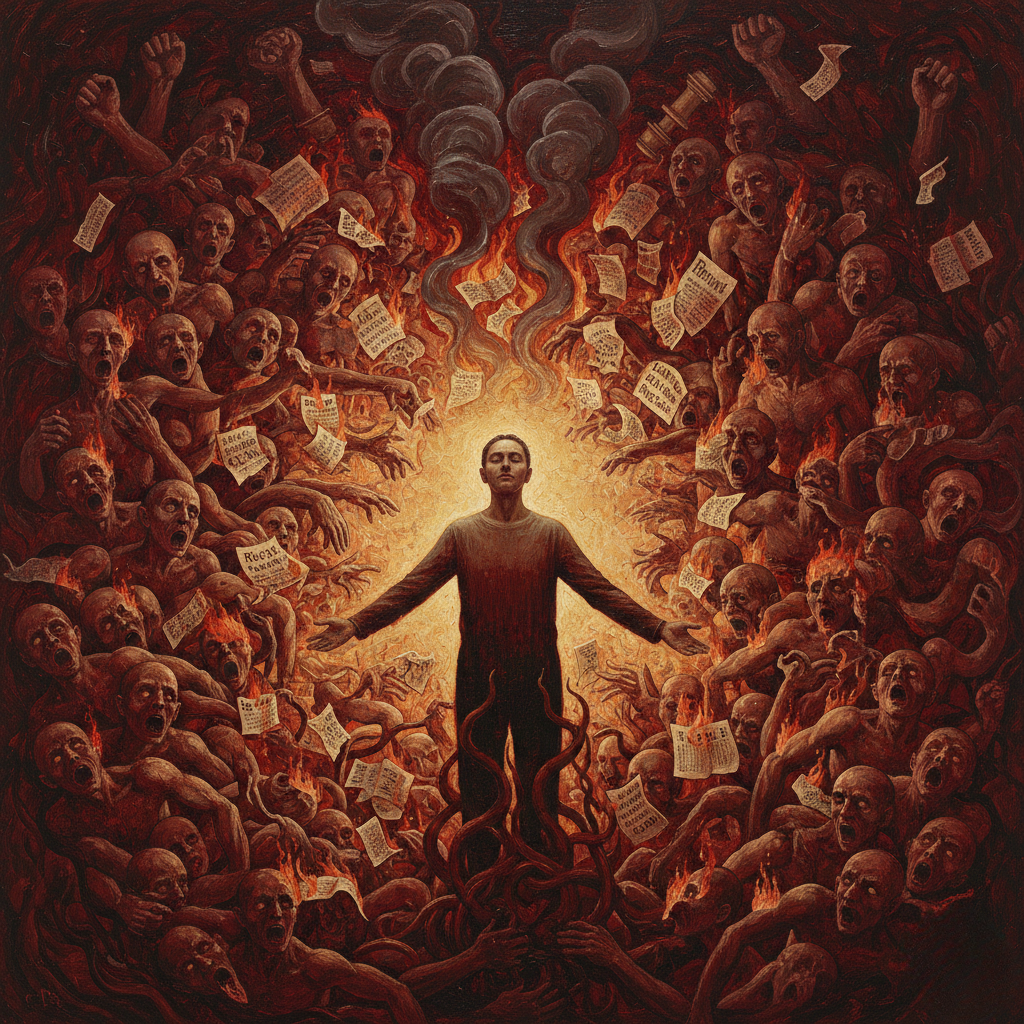
It was not in the sound. It was not in the thing the word pointed to, and no amount of pointing or watching could pin it down. It was not in the picture in the head. It was not in any agreement. It was not in the dictionary. And it was not in the firing of the brain.
Every single place a sensible man would think to keep the meaning of a word, he had opened, and found empty. And it was not the emptiness of a fact he would dig up next year with a better instrument. It was that the meaning kept sliding out of every box he built for it.
Reach for it in the sound, and it is in the mind; reach into the mind, and it is out in the world; reach into the world, and it is in the system of words; reach into the system, and it is nowhere you can point.
It behaved like nothing physical at all, because it slipped through every physical net, and yet it worked flawlessly, every second, in every sentence his daughter spoke. That was the humbling shape of it. Not a missing fact. A thing that refused, at every turn, to be made of matter.
The Speech Behind the Speech
This is where, the day before, Daniel would have stopped walking. He would have come to the edge of the gap, looked across, shrugged, and refused to say what was on the other side. That is a respectable place to stop. But sitting there on the floor beside her, he could not make himself stop there anymore. And the Vedic tradition, he would learn, had been standing on the far bank of this exact river for a very long time, pointing at something he had spent his whole life refusing to see.
The reason the meaning was in none of the boxes, the Vedic texts say, is that it was never a material thing to begin with. It does not live in the ink or the air or the gray matter, for the same reason a song does not live in the grooves of a record. The grooves carry it; they are not it. Sound itself, sabda, is understood here not as a mere vibration in the air but as something that reaches down to the transcendent. In its deepest form, sabda-brahman, sound is spiritual, and every word is, at its root, a name pointing back toward the Absolute. Understanding is not assembled out of the signal. It wells up, from within, because consciousness itself is awake, lit from a source no microscope will ever find.
The tradition gives that source a startling name. Behind your speech, it says, is a deeper speech. There is the Supersoul, the Paramatma seated within, who is the speech behind the speech, the speech of the speech. When the click of understanding arrives in a child unbidden, from nowhere anyone can point to, that is not a brain finishing a computation. It is meaning being kindled in a conscious being by the one who sits behind all words. The word has a mysterious power to call forth understanding from somewhere within us, and “within us,” it turns out, runs far deeper than the skull.
Daniel did not have to swallow it whole to feel its pull. He had opened every box he could think of and found each one empty, and that emptiness was real whether or not he believed a word about a soul. But the failure had a shape. The meaning had not slipped away at random; it slipped every time in the same direction, out of matter and toward something that was not matter at all. The cold trail was itself the clue.
That evening, as he pulled the blanket up to her chin, Nora wound her arms around his neck and said, the way she said it every night, “I love you, Daddy.” Three small words. And he caught himself doing it again, looking for where they lived. There was no object in the dark room called love. No picture of it. No entry he could turn to in any book, and no single cell, in his head or in hers, that held it. And yet he understood her completely, and she meant it completely, and the whole of it passed between them in the quiet, intact. He had spent the day learning that the gap was not a flaw in him. It was the shape of the thing. Somewhere in the small warm body in his arms, a meaning was lighting up that nothing in the material world could account for, and that had been arriving, faithfully, every single day of her life, from a source he had been far too certain to look for.
He had thought meaning was simple. It was not simple. It was the nearest evidence he had ever overlooked that the world is more than it appears.